

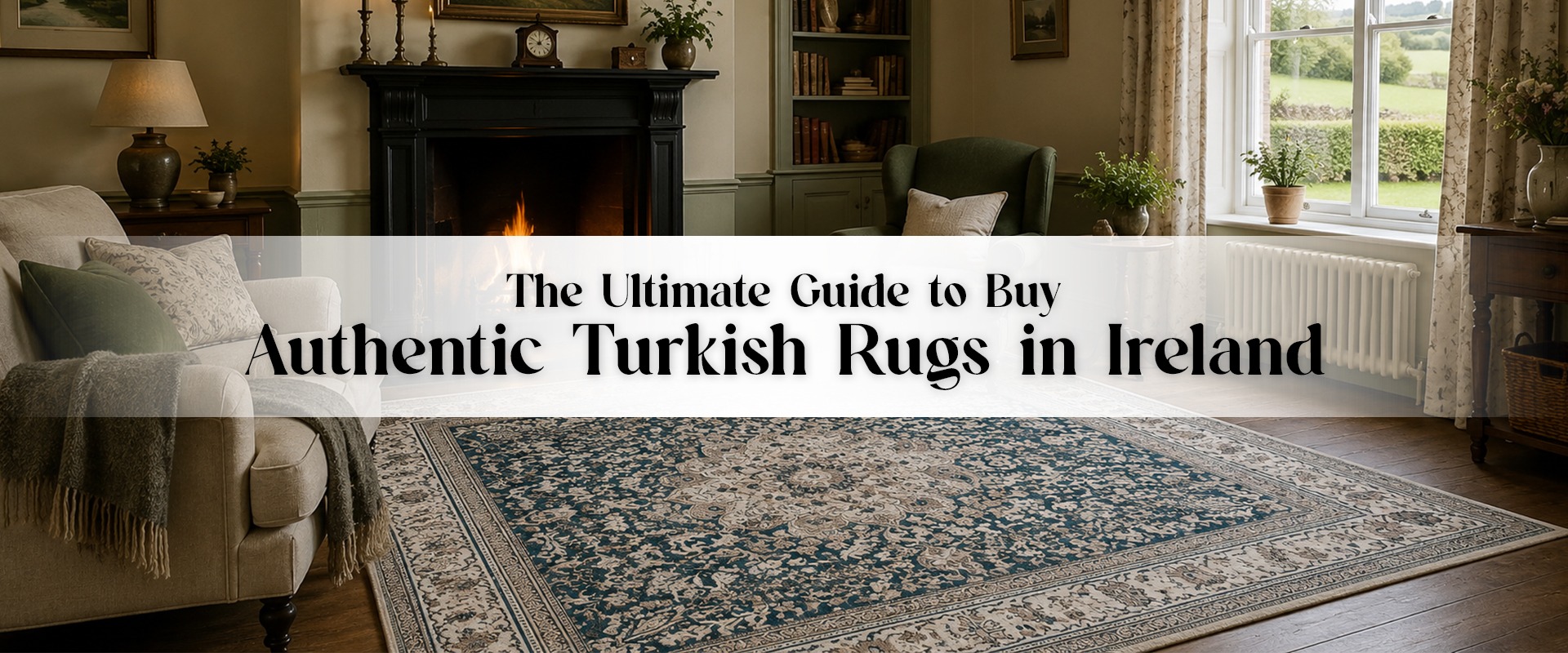
The best way to start today’s topic is by acknowledging the fact that you can buy authentic Turkish rugs online in Ireland at the best prices from Rugshop. How do you know they are genuine? We understand that sometimes exotic finds aren't just for the eyes only; conscious buyers out there are inclined to reach out to the roots to buy rugs from Turkey, which amass social, cultural and historical value. We are here to oblige.
Let's find out the discerning features of natural materials, craftsmanship and traditional patterns of Hereke, Oushak, Kilim and Gabbeh that covered the floors of Ottoman palaces, lined the interiors of nomadic tents, adorned the walls of mosques, and then grace your home.
Turkish Rugs at a Glance: Discerning Features That Make Them Special
A Turkish rug, or Türk halısı, is primarily a hand-woven wool or cotton rug or a flat-woven "durries"-type tapestry. While fine, luxurious Turkish silk rugs exist—particularly from Hereke—silk is generally more heavily associated with the extremely high knot-count, luxury urban production of Persian rugs. Turkish rugs have a more modest, humble background, rooted in nomadic and village traditions, designed for practical, daily use.
The craft dates back over 2,500 years, with some of the oldest surviving specimens housed in museums across Istanbul, Berlin, and New York. These rugs were never incidental objects. They served as prayer mats passed from grandmother to granddaughter. Today, Turkish rugs remain one of the most sought-after handmade rugs for sale in the world — and for very good reason.
Turkish Rugs vs Persian Rugs: What's the Difference?
This is the question every discerning buyer eventually asks, and it's a fair one. Both are revered. Both are handmade. But they are distinctly different in technique, aesthetic, and cultural DNA.
The knot tells the tale. Turkish rugs have symmetrical knots, known as Ghiordes or Turkish knots. The yarn wraps around two warp threads, and both ends emerge side by side. Traditionally, these are hand-knotted; nowadays, machine-made versions do exist that originate from the same villages.
Persian rugs, by contrast, typically use the asymmetrical knot (Senneh knot), where the yarn wraps around one thread and under the other. This seemingly small difference has a profound impact on texture and pile density. Turkish rugs tend to have a bolder, more geometric aesthetic — angular medallions, strong borders, and high-contrast colour blocking. Persian rugs lean toward intricate floral motifs and curvilinear designs. Neither is superior; they simply speak different visual languages.
There's also a material distinction worth noting. Many traditional Turkish rugs are woven with wool on wool — robust, warm, and extraordinarily durable — while Persian pieces often incorporate silk highlights. Both traditions produce remarkable textiles, but Turkish rugs earn a particular reputation for hardwearing longevity. A well-made Turkish rug can outlast generations of owners without losing its character.
The Techniques That Make Turkish Rugs Singular
The craft of Turkish rug-making is not a production-line process. It is painstaking, intentional, and deeply human.
Hand-knotting remains the gold standard. A single square metre of a high-quality Turkish rug can contain upwards of 400,000 individual knots. Skilled weavers — often working from memory rather than printed patterns — can take months or even years to complete a single piece.
Regional traditions vary considerably: rugs from Hereke are known for their extraordinarily fine silk work; those from Oushak (Uşak) are celebrated for their soft, muted palettes and oversized medallion formats; Kilims from central Anatolia use a flat-weave technique with no pile at all, producing lighter, reversible textiles rich in geometric symbolism.
The dyes used in authentic Turkish rugs deserve particular mention. Traditional weavers used plant-based and mineral dyes – pomegranate rind, indigo, madder root, and walnut husks – that age gracefully and actually improve in appearance over decades. Modern authentic pieces honour these traditions, avoiding the harsh synthetic dyes that cause colours to bleed or fade unflatteringly.
How to Spot a Genuine Turkish Rug in the Modern World
In the modern world, you can buy rugs from Turkey online while in Ireland. Staying true to the sociocultural originality requires a certain amount of informed confidence. Here's what separates a genuine Turkish rug from a convincing imitation:
- Check the back. On a hand-knotted rug, the back mirrors the front almost perfectly, with individual knots clearly visible. Machine-made rugs have a canvas or latex backing.
- Irregularities are a hallmark. Perfect symmetry is the fingerprint of a machine. Slight variations in pattern, pile height, or colour saturation indicate human hands — and are considered marks of authenticity, not defects.
- Patterns: The patterns they reproduce carry meaning: tree-of-life motifs, evil eye (nazar) symbols, stylised birds representing freedom, and hands-on-hips patterns that signify fertility. Every rug is a coded story.
- The fringe is structural. On a genuine hand-knotted rug, the fringe is an extension of the warp threads — it is part of the rug. On imitations, fringe is sewn on as decoration.
- Material: Authentic Turkish rugs are made from wool, cotton, silk, or a combination. If a rug is categorised as synthetic, it is not traditional.
The People Behind the Pattern: Why This Purchase Matters
Here is a truth that the rug industry doesn't always tell you: when you buy a cheap, mass-produced imitation of a Turkish rug, someone loses. Weavers spend lifetimes mastering a craft that has been part of their family for centuries.
Buying an authentic Turkish rug is an act of cultural solidarity. These are not abstract crafts produced in factories — they are made by real people, often women in rural communities, for whom rug-weaving represents both livelihood and legacy. If you are looking to buy rugs from Turkey online in Ireland to be a part of that legacy, originality is the mainstay.
For the Turkish diaspora living in Ireland — and it is a community that has quietly grown across Dublin, Cork, Galway and beyond — owning an authentic Turkish rug is something far more than interior decoration. It is an anchor. A piece of home has been rolled out on foreign ground.
This is the emotional weight that mass-produced rugs simply cannot carry. No algorithm can replicate meaning. We are only here to connect the worlds.
Buying Turkish Rugs in Ireland: What You Need to Know
Sourcing genuine rugs in Ireland used to mean expensive trips abroad or hunting through specialist dealers in Dublin with uncertain provenance and inflated prices. That landscape has changed.
Rugshop now offers a curated range of 100% authentic Turkish rugs available for purchase online in Ireland. We personally partner with real craftsmen and artisans in Turkey and across the Turkish diaspora in Ireland to source each piece. Each one is a story. Each one is special.
Frequently Asked Questions
Yes, authentic hand-knotted rugs are significantly more durable than machine-made Turkish rugs. They are made from high-quality natural materials such as wool or silk and are labour-intensive, with individual knotting that gives them immense durability, allowing them to last for generations. Machine-made rugs, due to the use of synthetic fibres and adhesives, may deteriorate within a couple of years.
Yes, and in fact, Turkish wool rugs perform admirably with underfloor heating. Wool is a natural insulator that regulates heat without degrading, and it won't harbour the static or off-gassing associated with synthetic pile rugs. Do ensure there's a breathable rug pad underneath to allow airflow, and avoid placing very thick rugs over systems set above 27°C.
Quite a lot, actually. Turkish-style machine-made rugs typically use synthetic fibres that flatten and pill within a few years, colours that fade unevenly and have no cultural or craft heritage whatsoever. An authentic Turkish rug, by contrast, becomes more characterful with age — the pile softens, the dyes deepen, and the rug effectively becomes a family heirloom. The cost per year of ownership often significantly favours the authentic piece.
Absolutely — and this is actually where the hardwearing nature of traditional Turkish weaving shines. Go for tightly knotted flatweaves or short-pile rugs, such as Kilim, that are catchy and effortless to clean and maintain.
Turkish rugs are inherently not as expensive as luxury Persian or Oriental rugs. They embody historic and cultural value, as well as meticulous craftsmanship, which the modern world and Rugshop recognise. An authentic rug carries regional identity, family tradition, and craft lineage. It's a matter of artistic and sociocultural values.