

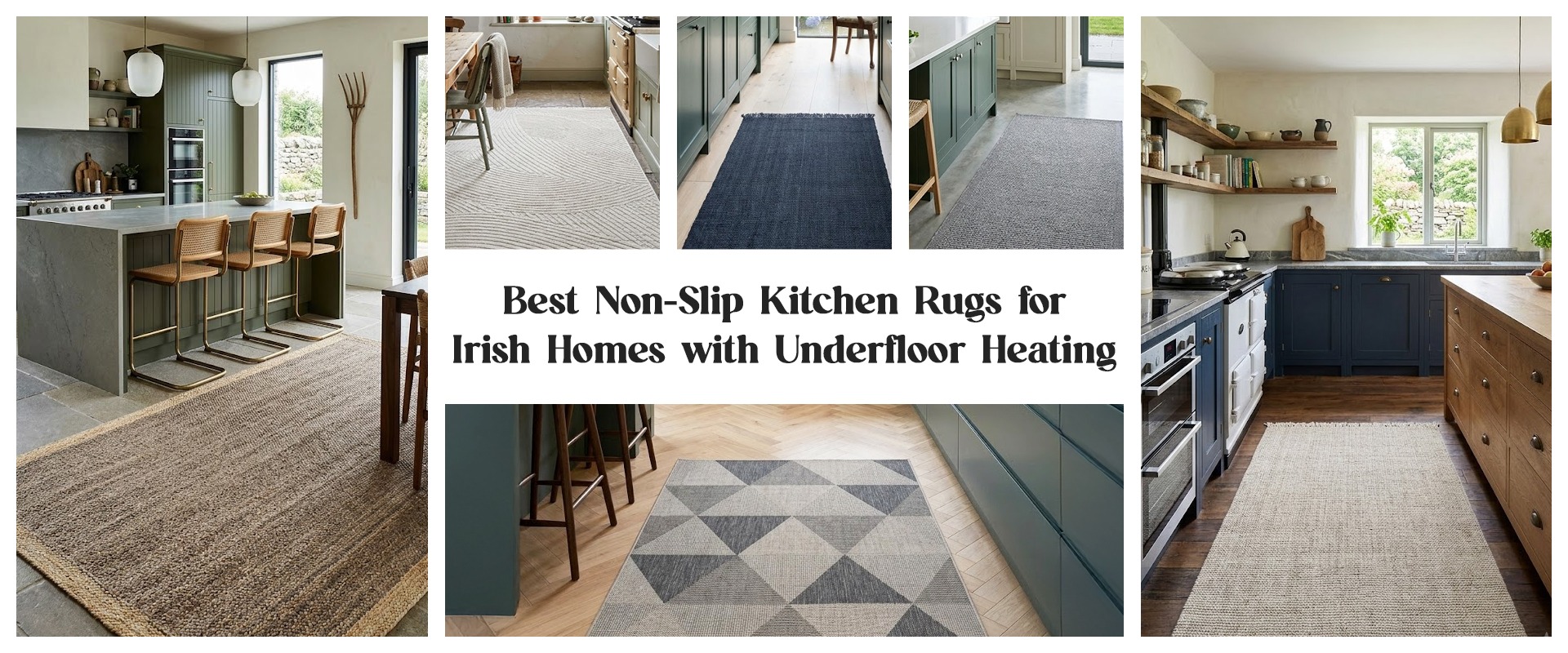
An increasing number of Irish self-builds and renovations are opting for underfloor heating, especially in the kitchen, where tiled or polished concrete floors are very popular. It makes sense on paper: no bulky radiators taking up wall space, no cold feet on a January morning, and a cleaner look overall. But then comes the question that tends to get asked only after the floor is already down: what rug do you actually put on top of it?
As one of Ireland's largest stockists of kitchen rugs, Rugshop IE offers a wide range of non-slip kitchen rugs, machine-washable designs, and options suitable for homes with underfloor heating.
So what’s the right choice for you? It's not as simple as picking whatever looks nice in the showroom. Get it wrong, and you could end up with a rug that curls at the edges, slides about every time someone walks across it, or quietly stops your underfloor heating from doing its job properly. Get it right, and the kitchen becomes the warmest, most liveable room in the house, just as it should be. So let's find out what really works for your kitchen.
Why the Kitchen Floor Is a Different Kind of Challenge
A kitchen floor sees more traffic, more moisture, and more sudden temperature changes than almost any other room in the house. There's the school-morning rush, the dog's water bowl that never quite stays where it's meant to, the odd splash from the kettle, and the general to-and-fro of daily life. Add underfloor heating into that mix, and the floor itself is also gently warming and expanding under your feet throughout the day.
Most people don't choose to buy non-slip kitchen rugs in Ireland purely for decorative reasons. It is a functional need. It's doing a job: giving you somewhere soft and safe to stand at the sink or hob, softening the sound of footsteps on tile, and taking the edge off a floor that can otherwise feel unforgiving on weary legs at the end of a long day.
The Slipping Problem Nobody Talks About Until It Happens
Here's a scenario that most Irish households with tiled kitchens will recognise. In a typical scenario, a person is cooking, the floor is slightly damp from a splash near the sink, and the rug that seemed perfectly stable in the shop suddenly slides a few inches when a foot lands on its edge.
It's rarely dramatic, but it's exactly the kind of moment that leads to a stumble, a dropped pot, or worse. Tiled and polished floors are also the surfaces most commonly paired with underfloor heating, making rug stability even more important. This is a common scenario that stresses the need for a stable, non-slip rug for kitchen floors —one that stays in its place even amid high traffic.
Smooth surfaces simply don't grip a plain rug backing the way carpet or timber would. This is precisely why non-slip backing isn't a nice-to-have for a kitchen rug; it's the single most important feature to check before anything else.
What Underfloor Heating Actually Does to a Rug
The heating element is the part that can sometimes be a little misleading for anyone looking to buy a kitchen rug in Ireland. Underfloor heating works by warming the floor slab or screed, which then radiates heat upward into the room.
Anything placed on top of that floor, including a rug, acts as an insulating layer. Too thick or too dense a rug, and you're effectively putting a blanket over your heating system, trapping the warmth below rather than letting it into the room.
There's a second, quieter issue too. Some rug backings, particularly PVC or rubber-based ones, aren't designed to be exposed to sustained warmth from below. Over time, repeated heat exposure can cause certain backings to harden, crack, or curl at the edges, especially at the corners where the rug meets the tile. It's a gradual process, so it's often only noticed months later, when the rug that lay perfectly flat at Christmas is lifted at the edges by Easter.
Understanding Tog Ratings Before You Buy
Okay, “tog rating” might be quite a technical term for anyone looking to buy rugs for the kitchen floor in Ireland; however, if there's one number worth learning before choosing a kitchen rug for a heated floor, it's this.
Tog measures thermal resistance, essentially how much a material blocks heat from passing through it. The higher the tog rating, the more insulating the rug, and the more it will block heat from reaching your feet and your room.
Where tog information is available, a lower tog value generally allows heat to pass through more efficiently. Manufacturers don't always publish tog ratings for individual rugs, so choosing a thinner, low-pile rug is often the most practical approach.
It's worth checking this detail on the product page before adding anything to the basket, rather than assuming a rug will "probably be grand".
Non-Slip Backing: The Feature to Check First
Not all non-slip backing is created equal, and it's worth knowing what you're actually looking for. Common options include:
- Latex, which grips well on tile and stone but can be more sensitive to sustained heat over time.
- TPR (thermoplastic rubber) backing, a slightly more flexible and heat-tolerant option, often used on modern washable rugs.
- Non-slip mesh or dot backing, lightweight and breathable, allowing heat to pass through more freely than a solid rubber sheet.
For a kitchen with underfloor heating, a breathable, low-profile non-slip backing tends to strike the best balance between grip and heat transfer. If you're layering a rug over an existing anti-slip underlay rather than relying on the rug's built-in backing, check that the underlay itself is also rated as heat-safe, as not all of them are.
Washable Kitchen Rugs: A Practical Match for Irish Life
Kitchens are where accidents happen most: a splash of red sauce, a dropped glass of milk, muddy paw prints after a walk in the rain. A machine-washable kitchen rug takes the stress out of these moments considerably. Instead of grabbing stain remover and crossing your fingers, you just pop it in the drum on a gentle cycle.
Machine-washable kitchen rugs are largely compatible with underfloor heating. The thin, flexible construction fits in standard washing machines and naturally has a lower tog rating than a thick, hand-tufted wool rug. What's convenient for laundry day also happens to be convenient for heat transfer, which is a rare bit of good luck.
Choosing the Right Material for a Heated Kitchen Floor
Material matters just as much as backing when it comes to heat compatibility and everyday practicality.
- Cotton flatweave rugs are lightweight, breathable, and typically machine washable, making them a sound all-rounder for kitchens.
- Polypropylene and polyester blends resist staining and dry quickly, both useful traits near a sink or hob.
- Wool, while lovely underfoot in a sitting room, is generally too dense and too high in tog rating to suit a heated kitchen floor, and it's slower to dry if it gets wet.
- Jute and sisal, while durable and popular for hallways, can feel rough underfoot when bare feet are involved, and natural fibres don't always take kindly to repeated moisture near the kitchen sink.
For most Irish kitchens with underfloor heating, a cotton or polypropylene flatweave with a breathable non-slip backing strikes a good balance between comfort, durability, and heat compatibility.
Getting the Size and Placement Right
A common mistake is buying a rug that's either too small to be useful or too large to be practical.
A narrow runner works well in front of the sink or along a galley-style counter, giving a soft landing spot exactly where you stand for the longest. A slightly larger rectangular rug can anchor a kitchen island or a dining area within an open-plan space.
Whatever the shape, it's worth leaving a small gap, roughly 5 to 10 centimetres, between the rug and any heat-sensitive fittings like the base of the oven or dishwasher. This keeps airflow moving and avoids trapping heat in one spot on the floor for too long.
Caring for a Kitchen Rug on a Heated Floor
A few small habits go a long way in keeping a kitchen rug looking and performing well over time:
- Lift and check occasionally. Every few months, lift the rug and check the backing for any early signs of cracking or hardening near the edges.
- Avoid leaving it permanently over the hottest zone. If your underfloor heating has manifold zones, try not to leave a rug parked directly over the warmest loop for months on end.
- Wash on a gentle, low-heat cycle. High heat in the washing machine or tumble dryer can be just as tough on backing as heat from the floor. Air-drying flat is the safer option for most machine-washable kitchen rugs.
- Vacuum with suction only. A beater bar can fray the edges of a flatweave rug over time, so suction-only mode is the gentler choice for daily upkeep.
Bringing It All Together
If you are looking to buy a kitchen rug in Ireland with non-slip features and underfloor heating compatibility, it comes down to a short list of details that genuinely matter:
- - a low tog rating
- - a breathable mesh or latex backing
- - a washable and low-pile construction
- - a size and placement that suits how the kitchen is actually used day to day.
None of this needs to come at the expense of style. There are farmhouse checks, understated stripes, and warm neutral flatweaves that tick every practical box while still looking good against tile, timber, or polished concrete.
If you'd rather not spend an evening comparing tog ratings and backing types across a dozen different websites, Rugshop's collection of kitchen rugs for sale in Ireland has already been put together with these Irish kitchen realities in mind, with washable, low-profile, non-slip options suited to underfloor heating alongside styles built for busier households and heavier footfall. It's worth a browse before your next kitchen refresh, if only to see how many boxes a single rug can genuinely tick.
Frequently Asked Questions
To a degree, yes, though usually not dramatically if the rug is chosen carefully. A thick, high-tog rug can slow down how quickly heat reaches the room and may cause the floor sensor to read a cooler temperature than the surface actually is, leading the system to run longer than necessary. A thin, low-tog rug has a much smaller effect and is generally considered safe to use without adjusting your heating settings.
Standard felt or foam underlays are usually too insulating for a heated floor and can trap warmth beneath the rug rather than letting it rise into the room. If extra grip or cushioning is needed, look specifically for underlays labelled as suitable for underfloor heating, which tend to use a thinner, more open weave designed to let heat pass through rather than block it.
There's a small amount of truth to this, though it's more about ambient room temperature than the underfloor heating system itself. Darker colours absorb more heat from natural light through windows, so a dark rug in a sunny spot may feel marginally warmer to the touch than a pale one nearby. The underfloor heating output itself isn't affected by rug colour.
This usually comes down to localised temperature and moisture changes rather than a fault with the rug itself. Areas near a cooker or sink experience more frequent temperature swings and occasional dampness, which can cause certain backings to expand and contract unevenly over time, leading to curling right at the corners. Switching to a rug with a more flexible, breathable backing, or adding rug grippers at the affected corners, usually resolves it.
A simple way to check is to feel the floor temperature both under the rug and just beside it after the heating has been running for a while. If the exposed tile feels noticeably warmer than the area under the rug, the rug is likely acting as an insulator. Persistent cold spots directly under a rug, combined with the rest of the kitchen floor feeling evenly warm, can indicate that it's time for a lower-tog alternative.